

Defence Science and Technology Publications
Publications directly from Defence Science and Technology
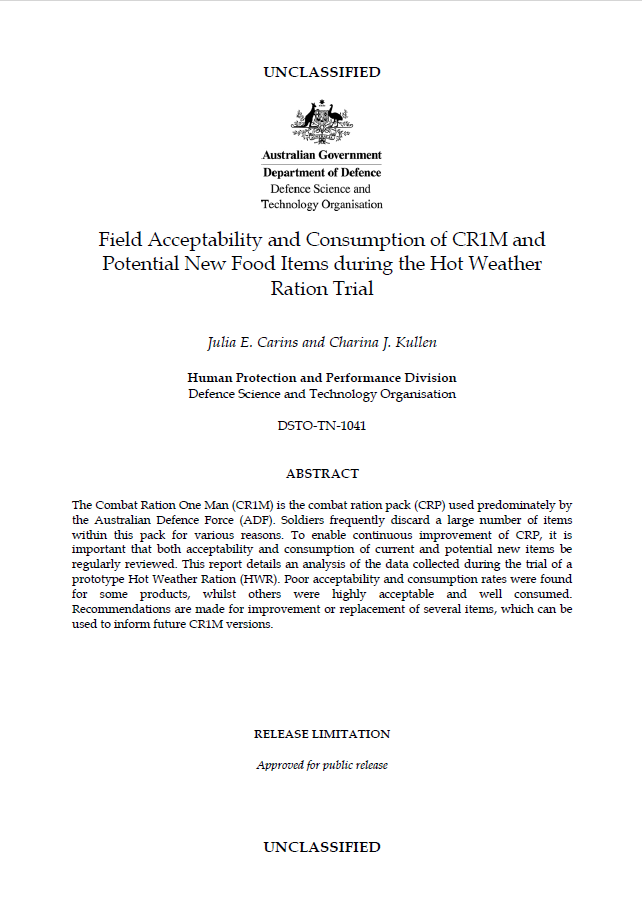
The Combat Ration One Man (CR1M) is the combat ration pack (CRP) used predominately by the Australian Defence Force (ADF). Soldiers frequently discard a large number of items within this pack for various reasons. To enable continuous improvement of CRP, it is important that both acceptability and consumption of current and potential new items be regularly reviewed. This report details an analysis of the data collected during the trial of a prototype Hot Weather Ration (HWR). Poor acceptability and consumption rates were found for some products, whilst others were highly acceptable and well consumed. Recommendations are made for improvement or replacement of several items, which can be used to inform future CR1M versions.
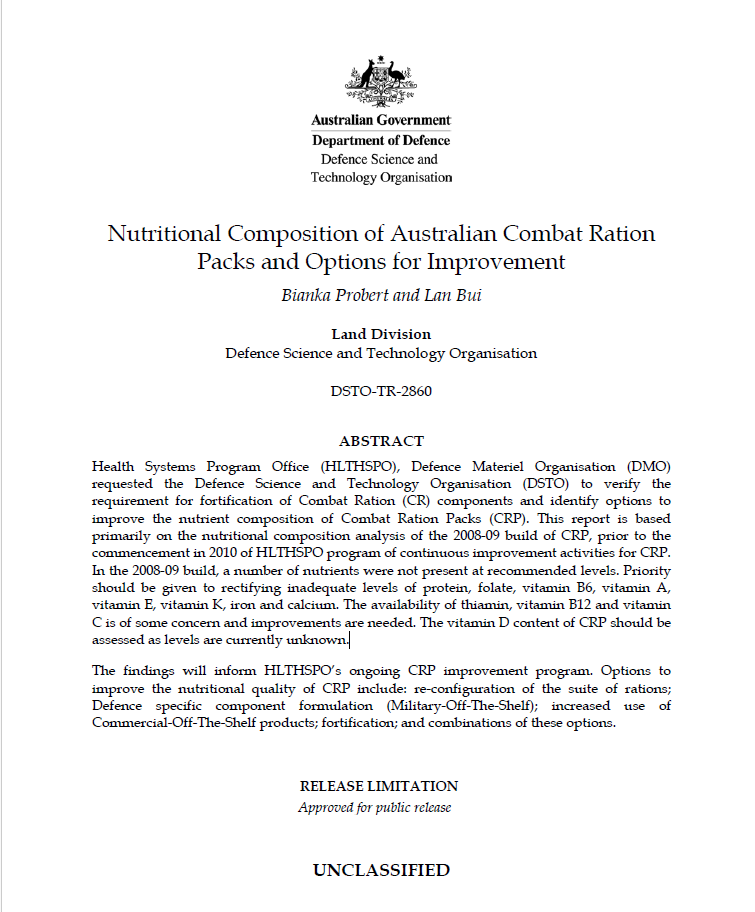
Health Systems Program Office (HLTHSPO), Defence Materiel Organisation (DMO) requested the Defence Science and Technology Organisation (DSTO) to verify the requirement for fortification of Combat Ration (CR) components and identify options to improve the nutrient composition of Combat Ration Packs (CRP). This report is based primarily on the nutritional composition analysis of the 2008-09 build of CRP, prior to the commencement in 2010 of HLTHSPO program of continuous improvement activities for CRP. In the 2008-09 build, a number of nutrients were not present at recommended levels. Priority should be given to rectifying inadequate levels of protein, folate, vitamin B6, vitamin A, vitamin E, vitamin K, iron and calcium. The availability of thiamin, vitamin B12 and vitamin C is of some concern and improvements are needed. The vitamin D content of CRP should be assessed as levels are currently unknown.
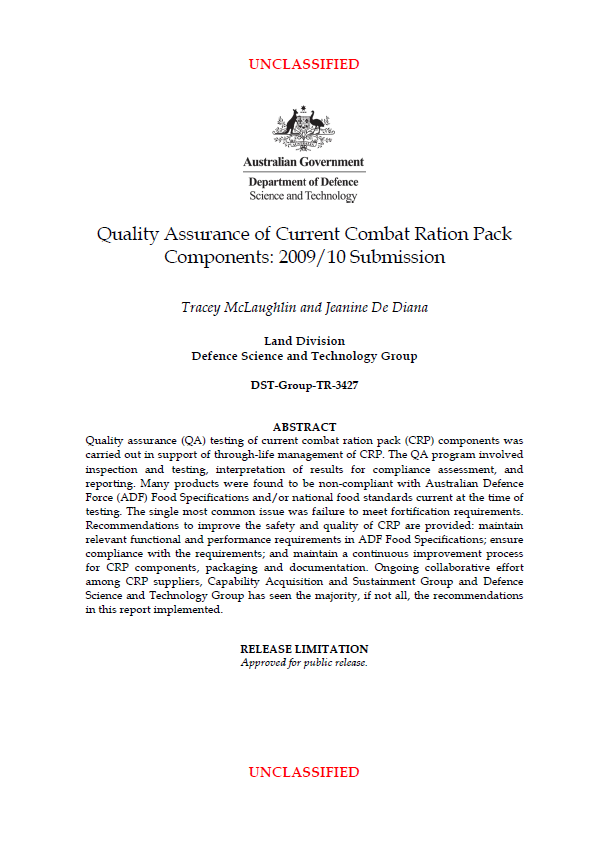
Quality assurance (QA) testing of current combat ration pack (CRP) components was carried out in support of through-life management of CRP. The QA program involved inspection and testing, interpretation of results for compliance assessment, and reporting. Many products were found to be non-compliant with Australian Defence Force (ADF) Food Specifications and/or national food standards current at the time of testing. The single most common issue was failure to meet fortification requirements. Recommendations to improve the safety and quality of CRP are provided: maintain relevant functional and performance requirements in ADF Food Specifications; ensure compliance with the requirements; and maintain a continuous improvement process for CRP components, packaging and documentation. Ongoing collaborative effort among CRP suppliers, Capability Acquisition and Sustainment Group and Defence Science and Technology Group has seen the majority, if not all, the recommendations in this report implemented.
The introduction of continual product improvement—whereby items are replaced or reformulated depending on feedback from soldiers and sensory evaluation of specific foods and beverages—has led to a steady improvement in both the nutritional quality and acceptability of combat rations. In addition, prototype ration packs have been developed for specific purposes and include light-weight rations, hot climates rations, and modular rations. Combat rations remain vital to the performance of our soldiers during training, on field exercises and on operations. Continued research in Defence food and nutrition is essential to ensure that ADF members are provided with combat rations that deliver the nutrition required to sustain optimal cognitive and physical performance.
Soldiers rarely consume all the food components issued in combat ration packs (CRP), compromising the adequacy of nutrient intake and the physical and cognitive performance of combatants. Mission adaptive (MA) nutrition—providing soldiers with optimal energy and nutrients when Army operates in contemporary environments and with changing demands—is thought to mitigate risk to performance. In a side-by-side comparison with in-service CRP, a nutrient optimised modular MA CRP design was fielded with dismounted infantry personnel to assess fitness-for-purpose and utilisation over a 6–day use period. Inadequate energy and nutrient intakes were identified as a result of the field trial. A detailed understanding of combatant energy expenditure, current and future risks to health and well-being and performance targets is required to optimise the design and provide a proof of concept. Further product development, potentially including formulated, energy-dense, and commercial-off-theshelf components, is required to rectify the inadequate delivery of nutrients. Successful implementation of a MA CRP design will require training, education, policy and procedure, and interactive tools for verification of learning, validation of desirable behaviour and realisation of benefits. To provide a proof of concept, further trials are required to assess performance in various operational environments over longer use periods of up to 30 days
Increasingly demanding and varying operational situations, combined with underconsumption of ration pack items, questions the suitability of current CRP for modern military operations. A project was thus undertaken to explore alternative ration pack configurations and to elicit the views of military personnel likely to use them. Six ration concepts were developed; two lightweight options, two whole-day options; and a modular option. A qualitative evaluation of these ration concepts revealed that four were considered promising and worthy of further development. Three broad courses of action were also identified—improving the current CR1M, introducing lightweight options and developing modular rations. It is recommended that:
The merits of each of these actions be investigated; and
A case be developed for each of these options to be pursued in series—progressing from improvements to the existing CR1M, to the introduction of light-weight options (which may become modules), then finally to modular rations.
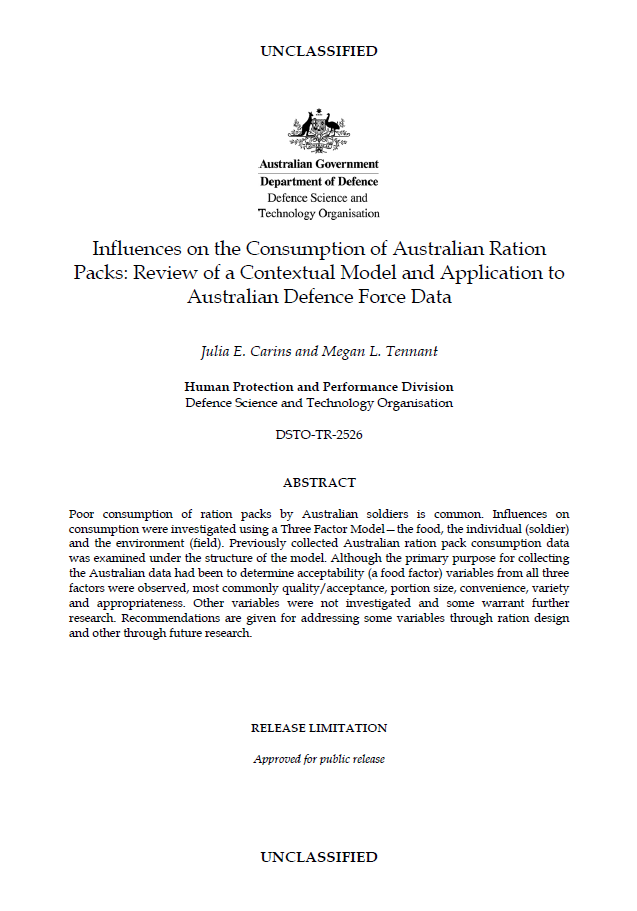
Poor consumption of ration packs by Australian soldiers is common. Influences on consumption were investigated using a Three Factor Model—the food, the individual (soldier) and the environment (field). Previously collected Australian ration pack consumption data was examined under the structure of the model. Although the primary purpose for collecting the Australian data had been to determine acceptability (a food factor) variables from all three factors were observed, most commonly quality/acceptance, portion size, convenience, variety and appropriateness. Other variables were not investigated and some warrant further research. Recommendations are given for addressing some variables through ration design and other through future research.